The amended Medical Service Act (Act No. 21238), which preserves in-person care as the general rule while permitting telemedicine between healthcare professionals and patients where prescribed requirements are met, takes effect on December 24, 2026. In anticipation, the Ministry of Health and Welfare (“MOHW”) has published for public comment draft partial amendments to the Enforcement Decree of the Medical Service Act (MOHW Public Notice No. 2026-743, published September 23, 2026; the “Draft Decree”)1, the Enforcement Rule of the Medical Service Act (MOHW Public Notice No. 2026-780; the “Draft Enforcement Rule”)2, and the Rule on Administrative Dispositions Concerning Medical Services (MOHW Public Notice No. 2026-782; the “Draft Disposition Rule,” and together with the Draft Decree and the Draft Enforcement Rule, the “Draft Regulations”; each published October 19, 2026)3, which set out the detailed standards delegated by the Act. On November 10, 2026, the MOHW further published for public comment a proposed Public Notice on the Provision and Management of Telemedicine (MOHW Public Notice No. 2026-857; the “Draft Notice”).4
With approximately five weeks remaining before the effective date, businesses in the sector would be well advised to identify in advance, on the basis of the proposed texts, the service and system changes that will be required. In addition, the amended Pharmaceutical Affairs Act (Act No. 21937; the “PAA”), effective September 16, 2027, disqualifies telemedicine platform operators that have filed a notification under the amended Medical Service Act from holding a pharmaceutical wholesale license and restricts sales by wholesalers with which such operators have a special relationship (PAA Article 46, item 5, and Article 47(8); see our TLI of September 29, 2026). Because notification under the Medical Service Act will thus determine whether an operator falls within the reach of the PAA, compliance strategies under the two statutes should be designed in tandem.
1. Key Provisions of the Draft Regulations and the Draft Notice
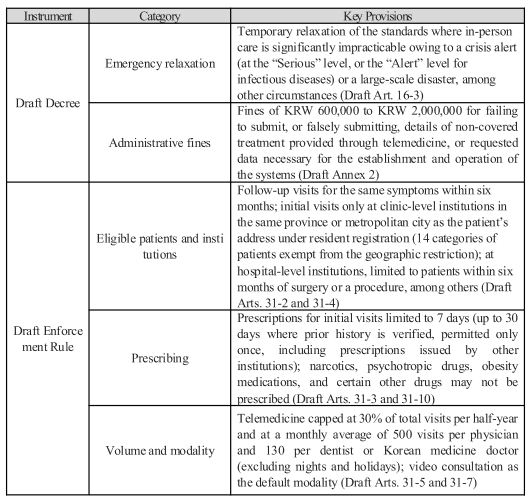
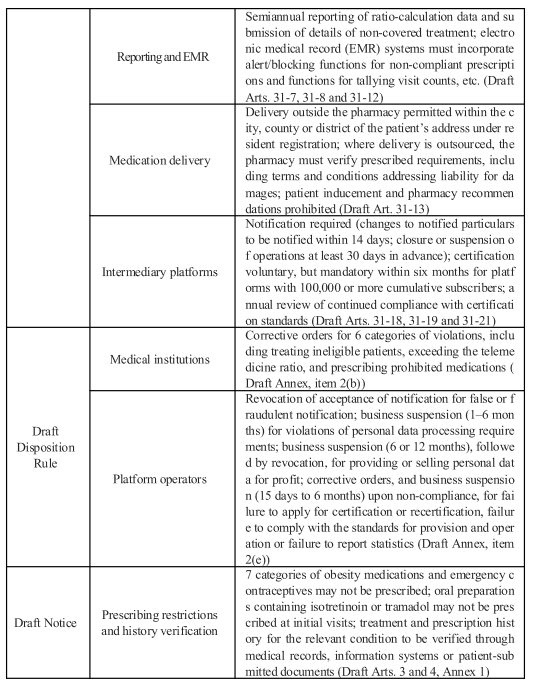
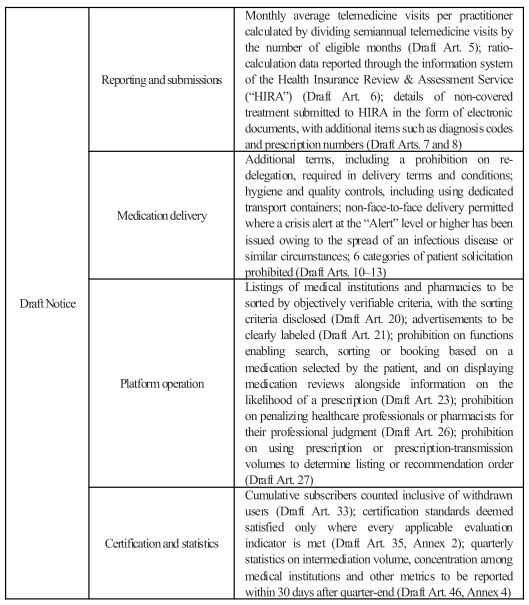
2. Compliance Checklist by Business Type
A. Telemedicine Platform Operators
Current law imposes no notification requirement on operators of telemedicine intermediary platforms. Once the amended Medical Service Act takes effect, however, any person seeking to provide or operate such a platform must
file a notification with the Minister of Health and Welfare, must obtain certification once its cumulative subscriber base reaches the prescribed threshold, and will be subject to business suspension and revocation of acceptance of notification for violations (Article 34-8 of the amended Act; Draft Disposition Rule, Article 2 and Annex, item 2(e)).
- Notification requirements: A platform’s mode of provision and operation must not constitute conduct prohibited under the amended Act and must conform to the prescribed standards for provision and operation (Article 34-9(1) of the amended Act; Draft Enforcement Rule, Article 31-18(2)). The notification must describe the platform’s intermediation method, including matching and sorting, and the basis on which user fees and commissions are calculated; any material change to the mode of provision and operation, such as the matching or sorting criteria, and any change relating to fees or commissions must be notified within 14 days (Draft Notice, Articles 15 and 16).
- Standards for provision and operation: Operators should review their consultation-request flows and interface design, promotions, fees, and display and sorting criteria against the standards for provision and operation set out in the Draft Notice (see the table above), and should segregate the platform’s information processing systems and databases if they are shared with other business units of the operator or its affiliates (Draft Notice, Article 28).
- Notification timeline: Platforms in operation on the effective date must file a notification within three months thereafter and, if they meet the cumulative subscriber threshold, apply for certification within six months (Addenda, Article 2 of the amended Act); the necessary service adjustments should therefore be completed before those deadlines.
- Certification: Other platforms must apply for certification within six months after the date on which their cumulative subscribers reach 100,000 (Draft Enforcement Rule, Article 31-19). Certification assessments are conducted through both document review and on-site inspection (Draft Notice, Article 37).
- Statistical reporting: The first report, covering Q4 2026 and Q1 2027, is due by April 30, 2027 (Draft Notice, Addenda, Article 2). Operators should accordingly have systems in place from the effective date to tally intermediation volumes by medical institution and prescription transmissions by pharmacy, and to retain the underlying data for three years (Draft Notice, Article 50).
B. Medical Institutions
- Verification and record-keeping: Before providing telemedicine, the practitioner rmust verify the patient’s identity and eligibility, the applicable requirements in the case of hospital-level institutions, and, for minors and certain other patients, the consent of the legal representative; after the consultation, the date and time, modality and other prescribed particulars must be entered in the medical records (Draft Enforcement Rule, Article 31-5(2) – (4) and (8)). Until the Telemedicine Support System becomes operational, whether a patient meets the same-region requirement or qualifies for an exemption from the geographic restriction may be verified through the information system of the National Health Insurance Service or relevant documents, and the patient’s actual residence through materials submitted by the patient (id., Article 31-5(6); Addenda, Article 6).
- Volume management: Because consultations conducted at night or on holidays and telemedicine provided under standards relaxed during an emergency are excluded from the ratio and volume calculations, and each practitioner’s period of service is factored into the calculation (Draft Enforcement Rule, Article 31-7(5); Draft Notice, Article 5), institutions will need record-keeping systems capable of segregating such consultations and of tracking practitioners’ periods of employment and leave.
- Prescription duration for initial visits: To prescribe for more than seven days, the practitioner must verify the patient’s treatment and prescription history for the relevant condition and whether the patient has already received such an extended prescription from another institution (Draft Enforcement Rule, Article 31-3(3) and (4)); institutions should therefore establish procedures for doing so by the methods prescribed in the Draft Notice (Draft Notice, Article 3).
- Non-covered treatment: Details must be submitted within three months after the end of each half-year (the first deadline being September 30, 2027) and must include, among other things, diagnosis codes, the dosage and duration of non-covered medications, and prescription numbers; institutions must therefore be able to extract this information on a per-visit basis (Draft Enforcement Rule, Article 31-8 and Addenda, Article 4; Draft Notice, Article 7).
C. Pharmacies and Delivery Providers
The amended Medical Service Act permits pharmacies to deliver medications outside the pharmacy only to patients residing on islands or in remote areas, recipients of long-term care benefits, registered persons with disabilities, patients with Class 1 or Class 2 infectious diseases, and patients with rare diseases (Article 34-5(1)). The Draft Enforcement Rule prescribes the geographic scope and method of delivery, and the Draft Notice sets out the detailed standards.
- Delivery area: Delivery is generally limited to the city, county or district in which the patient’s address under resident registration is located, extending, for patients with rare diseases, to the city, county or district of the medical institution at which the patient received treatment, and to the province or metropolitan city of that address where it is in a medically underserved area (Draft Enforcement Rule, Article 31-13(1)).
- Outsourced delivery: Pharmacy owners must themselves verify that the delivery provider’s terms and conditions and means of transport satisfy the prescribed requirements, and should check that the additional terms required by the Draft Notice are reflected in their delivery agreements (Draft Enforcement Rule, Article 31-13(3); Draft Notice, Article 10).
- Delivery obligations: Identity verification of the recipient and oral medication counseling are required; because in-person handover is the general rule, pharmacies currently relying on non-face-to-face delivery must establish in-person delivery procedures (Draft Enforcement Rule, Article 31-13(4); Draft Notice, Article 11, item 6, and Article 12).
- Patient solicitation: Because the provision of economic benefits such as gifts or delivery-fee waivers, as well as the forms of patient solicitation specified in the Draft Notice (e.g., co-payment reductions conditioned on the use of a particular platform), are prohibited, pharmacies and delivery providers should check whether their patient benefits and marketing practices fall within these prohibitions (Draft Enforcement Rule, Article 31-13(4), item 7; Draft Notice, Article 13).
- Receipt of prescriptions: Once the Electronic Prescription Transmission System becomes operational, pharmacies must retrieve prescriptions through the system within three days of their registration, register the completion of dispensing in the system, and notify the patient accordingly (Draft Enforcement Rule, Article 31-16(2) and (7)).
D. EMR Vendors
- Native functions: The obligations to incorporate functions for stating on the prescription that it was issued through telemedicine, issuing alerts or blocking prescriptions that breach prescribing restrictions or involve prohibited medications, separately tallying visit counts and ratios, and verifying medication information apply from December 24, 2026, without any grace period. Vendors should therefore have these functions in place before the effective date, reflecting the scope of restricted medications and the calculation methods set out in the Draft Notice (Draft Enforcement Rule, Article 31-12(1), items 1, 2 and 4–6; Draft Notice, Articles 4 and 5, Annex 1).
- Integration functions: Electronic prescription integration functions apply from the date on which the Electronic Prescription Transmission System commences operation and should be readied in line with the commencement date to be announced by the Minister of Health and Welfare (Draft Enforcement Rule, Article 31-12(1), item 3, and Addenda, Article 7).
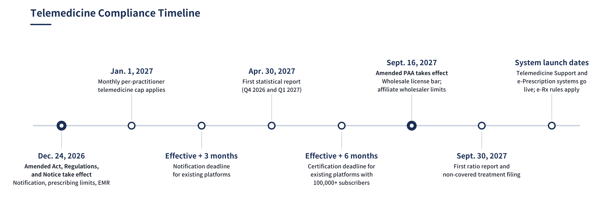
3. Compliance Timeline
The dates on which the principal obligations discussed above take effect, and the associated deadlines, are set out chronologically below.
4. Key Takeaways
A common thread running through the Draft Regulations and the Draft Notice is that compliance is to be secured at the design stage of services and systems. The notification requirements for platforms, the mandated EMR functionalities, and the Draft Notice’s rules on sorting, medication selection, and the use of prescription data are illustrative. Platform operators and EMR vendors should accordingly look beyond after-the-fact remediation and build regulatory requirements into the planning and development of their services and systems from the outset.
The regulatory perimeter is also widening. The amended Medical Service Act makes telemedicine platform operators direct subjects of notification, certification, and administrative sanctions, thereby governing how their services operate, while the PAA restricts their combination with pharmaceutical wholesale businesses and sales by wholesalers with which they have a special relationship, thereby governing their nexus to pharmaceutical distribution. Because the two statutes are linked through a single concept—the “platform operator that has filed a notification”—notification to operate a platform is not merely an administrative formality under the Medical Service Act; it also determines the applicability of the PAA. Platform operators should therefore assess both statutes together against a single, integrated business structure.
Moreover, the regime will not be complete on December 24, 2026. The Draft Regulations and the Draft Notice remain at the public-comment stage and may change in final form, and the provisions governing electronic prescriptions, as well as the certification standard relating to integration with the Telemedicine Support System, will apply only once the respective systems become operational. As the regime will take shape in stages, businesses in the sector should establish an ongoing compliance framework that tracks and implements obligations as they evolve, rather than relying on a one-time review timed to the effective date.
* * *
LIN's Digital Healthcare Team, part of the firm's AI, Platform & Technology (APT) Group, advises companies across the digital healthcare sector on complex regulatory and compliance matters, providing integrated, strategic counsel.
Should you have any questions concerning this TLI, please contact LIN's Digital Healthcare Team (+82 2 3477 8695),
Team Leader Taeeon Koo (tekoo@law-lin.com), Attorney Kyunghee Park (khpark@law-lin.com), Attorney Bomi Seo (bmseo@law-lin.com) or Foreign Attorney Changha Yoo (chyoo@law-lin.com).
1 MOHW Public Notice No. 2026-743, Legislative Notice of the Partial Amendment to the Enforcement Decree of the Medical Service Act (Sept. 23, 2026), National Participatory Legislation Center, https://opinion.lawmaking.go.kr/gcom/ogLmPp/88740
2 MOHW Public Notice No. 2026-780, Legislative Notice of the Partial Amendment to the Enforcement Rule of the Medical Service Act (Oct. 19, 2026), National Participatory Legislation Center, https://opinion.lawmaking.go.kr/gcom/ogLmPp/89052
3 MOHW Public Notice No. 2026-782, Legislative Notice of the Partial Amendment to the Rule on Administrative Dispositions Concerning Medical Services (Oct. 19, 2026), National Participatory Legislation Center, https://opinion.lawmaking.go.kr/gcom/ogLmPp/89050
4 MOHW Public Notice No. 2026-857, Administrative Notice of the Proposed Public Notice on the Provision and Management of Telemedicine (Nov. 10, 2026), MOHW, https://www.mohw.go.kr/board.es?mid=a10501010100&bid=0003&act=view&list_no=1492497