The Mobility Team at LIN LLC continuously monitors the latest news, legislative updates, and regulatory trends in the automotive industry and issues newsletters to clients on a periodic basis.
This newsletter is protected by copyright held by LIN LLC and may be freely used for non-commercial purposes, provided that the source is attributed (CC BY-NC).
Long centered on emissions and safety standards, EU vehicle regulation now extends to the materials used in vehicles and to their treatment at the end of life. The End-of-Life Vehicles Regulation, which entered into force on August 13 governs the entire life cycle, from design through end-of-life treatment, and, because compliance is a prerequisite to type-approval, functions in practice as a condition of access to the European market. This newsletter summarizes the Regulation’s principal requirements and their implications for Korean companies.
This newsletter is protected by copyright held by LIN LLC and may be freely used for non-commercial purposes, provided that the source is attributed (CC BY-NC).
Long centered on emissions and safety standards, EU vehicle regulation now extends to the materials used in vehicles and to their treatment at the end of life. The End-of-Life Vehicles Regulation, which entered into force on August 13 governs the entire life cycle, from design through end-of-life treatment, and, because compliance is a prerequisite to type-approval, functions in practice as a condition of access to the European market. This newsletter summarizes the Regulation’s principal requirements and their implications for Korean companies.
1. Entry into Force and Application Timeline
Regulation (EU) 2026/1738 on circularity requirements for vehicle design and on management of end-of-life vehicles (the “ELVR” or the “Regulation”) was published in the Official Journal of the European Union on July 24, 2026, and entered into force on August 13, 2026, the twentieth day following publication. The Regulation applies generally from September 1, 2028, with its principal obligations taking effect in stages thereafter.
The Regulation repeals and consolidates two existing instruments: the End-of-Life Vehicles Directive (Directive 2000/53/EC) and the 3R Type-Approval Directive (Directive 2005/64/EC). The latter governed the reusability, recyclability, and recoverability of vehicles. The form of the instrument has also changed, from a directive to a regulation. A directive takes effect only upon transposition into the national law of each Member State, whereas a regulation applies directly in every Member State without such measures. Under the previous regime, end-of-life vehicle obligations varied in the manner and timing of transposition from one Member State to another, leaving room to vary the level of response market by market, whereas a single standard will now apply to all Member States at the same time. As there is now less scope for deferrals or other regulatory relief from individual Member States, companies should align their compliance framework with the single standard.
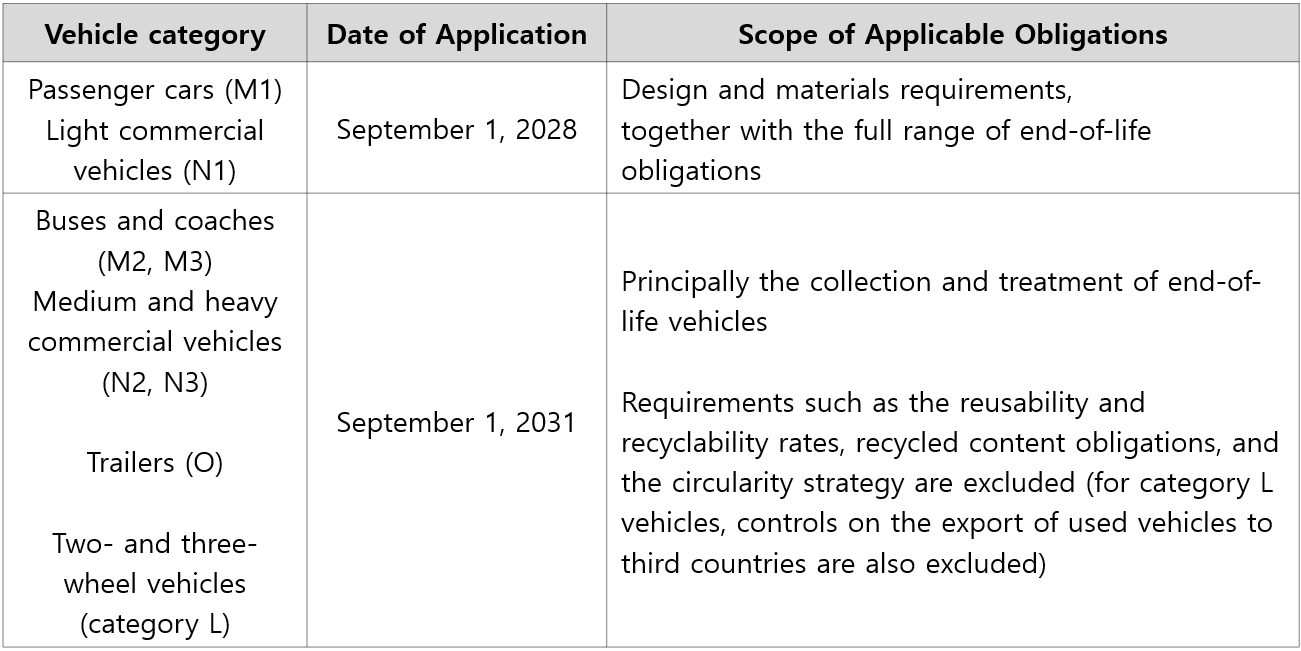
The timing and scope of application differ by vehicle category. Passenger cars and light commercial vehicles are covered from September 1, 2028, the date of the Regulation’s general application. Buses and coaches, medium and heavy commercial vehicles, trailers, and two- and three-wheel vehicles are covered from September 1, 2031. For the vehicle categories brought within scope later, requirements such as the recyclability rates and the recycled content obligation do not apply, and the obligations that do apply relate mainly to collection and treatment at the end-of-life stage. The scope of the applicable obligations thus varies from one vehicle category to another, as set out in detail below.
2. Circularity Requirements for Vehicle Design and Materials
The recycled content requirement appears to be the most direct burden on manufacturers. For each new vehicle type type-approved from September 1, 2032, manufacturers must source at least 15 percent of the plastic used in the vehicle, by weight, from feedstock recycled from post-consumer plastic waste; that threshold rises to at least 25 percent for types approved from September 1, 2036. At least 20 percent of that 15 percent (25 percent from 2036) must in turn consist of plastic recycled from end-of-life vehicles or from parts removed from a vehicle during its use phase. Manufacturers must therefore go beyond purchasing recycled feedstock and secure the channels through which materials are recovered from end-of-life vehicles. The Commission may, however, grant temporary derogations from these targets or adjust their timing where a lack of availability or excessive prices for recycled plastics render compliance excessively difficult.
Restrictions also apply to the sourcing of recycled feedstock. As a general rule, the material must be recycled at an installation within the European Union. From August 14, 2030, material recycled at an installation in a third country may also be counted toward the targets, provided that it satisfies the conditions prescribed by the Regulation. Third-country installations must be independently audited at least once every five years. A company intending to use feedstock recycled in Korea in vehicles destined for the European market must therefore look beyond the properties of the material itself, and ensure both that the recycling installation qualifies and that the audit arrangements are in place.
The design requirements have likewise been specified in greater detail. A vehicle type-approved from September 1, 2032, must satisfy both of the following mass-based thresholds: it must be constructed so as to be reusable or recyclable to a minimum of 85 percent by mass, and reusable or recoverable to a minimum of 95 percent by mass. Electric vehicle batteries, their battery packs, and e-drive motors must be designed so as to allow authorized treatment facilities or repair and maintenance operators to remove or replace them readily and without damage during both the use phase and the waste phase. Manufacturers must also collect data on the type and mass of every material used in the vehicle throughout the supply chain and establish procedures to verify the accuracy and completeness of the information received from suppliers.
3. Manufacturers’ Circularity Strategies and End-of-Life Vehicle Management
Under the Regulation, the first substantive obligation that manufacturers will face is not the recycled content requirement but the preparation of a circularity strategy. From September 1, 2029, each manufacturer must draw up a circularity strategy, submit a copy to the type-approval authorities of the Member States and to the European Commission within 30 days of its preparation, and update it at least once every five years. From the same date, manufacturers must provide end-of-life vehicle treatment operators, and repair and maintenance operators with the information necessary for the safe removal and replacement of electric vehicle batteries and their battery packs, parts containing critical raw materials, and comparable components. As the Commission will make circularity strategies publicly available, other than confidential information, manufacturers should determine their content with care from the drafting stage.
At the end-of-life stage, the Regulation introduces extended producer responsibility (“EPR”). EPR attaches to the party that first makes a vehicle available on the market of a given Member State, which may be the manufacturer but may equally be an importer or a distributor. From September 1, 2029, a producer must ensure that the vehicles it has made available, including those supplied prior to that date, are collected and treated once they become end-of-life vehicles, and must bear the associated costs. A producer may discharge these obligations itself or appoint a producer responsibility organization to do so on its behalf. Because the producer varies with the distribution structure, companies should first determine, on a Member State-by-Member State basis, whether the company itself or a local affiliate qualifies as the producer.
4. Conclusion and Implications
The Regulation applies from September 1, 2028, and the principal obligations of manufacturers take effect in stages from September 1, 2029. Securing recycled feedstock and designing for circularity, however, entail material development and validation, and the securing of supply sources, all of which require considerable time. Companies are accordingly advised to commence preparations well in advance of the applicable dates.
Furthermore, compliance with the Regulation is difficult to achieve through the response of vehicle manufacturers alone. Substantiating recycled content and material composition requires that the relevant data be collected and verified at every stage of the supply chain, and the burden of providing and managing that data extends to material and component suppliers. As that data will ultimately be obtained through contractual relationships, the scope of the data to be provided and the responsibility attaching to it should be addressed at the supply contract stage. A substantial number of matters, including the detailed criteria for the calculation and verification of recycled content, are left to subsequent legislation by the European Commission. Korean companies should therefore confirm the scope of the obligations applicable to them and follow the progress of the discussions on those criteria.
***
LIN LLC has extensive advisory and litigation experience across the mobility sector, ranging from automotive regulatory compliance and administrative proceedings to patent and trade secret disputes. The firm’s Mobility Team brings together attorneys and professionals with deep knowledge of, and hands-on experience in, the automotive and future mobility industries.
For further information on this newsletter, or for any inquiries, please contact the LIN Mobility Team:
Yong-Kap Kim, Attorney at Law (ygkim@law-lin.com, +82 2 3477 8695)
Min-Goo Kang, Attorney at Law (mgkang@law-lin.com, +82 10 3907 9217)
Jeong-Pil Oh, Attorney at Law (jpoh@law-lin.com, +82 2 3477 8695)
Keun-Hyeok Yook, Attorney at Law (keunhyeok.yook@law-lin.com, +82 2 3477 8695)
For further information on this newsletter, or for any inquiries, please contact the LIN Mobility Team:
Yong-Kap Kim, Attorney at Law (ygkim@law-lin.com, +82 2 3477 8695)
Min-Goo Kang, Attorney at Law (mgkang@law-lin.com, +82 10 3907 9217)
Jeong-Pil Oh, Attorney at Law (jpoh@law-lin.com, +82 2 3477 8695)
Keun-Hyeok Yook, Attorney at Law (keunhyeok.yook@law-lin.com, +82 2 3477 8695)