The Mobility Team at LIN LLC monitors the latest news, legislative developments, and regulatory trends in the automotive industry and shares its insights with clients on a periodic basis through this newsletter.
LIN LLC holds the copyright to this newsletter, which may be freely used for non-commercial purposes, provided that the source is properly attributed (CC BY-NC).
LIN LLC holds the copyright to this newsletter, which may be freely used for non-commercial purposes, provided that the source is properly attributed (CC BY-NC).
The European Union is advancing legislation to strengthen its domestic manufacturing base in strategic sectors such as electric vehicles and batteries. The Industrial Accelerator Act, proposed by the European Commission this past March, would introduce Union-origin requirements for electric vehicles in public procurement and subsidy programs, and impose conditions on foreign direct investments exceeding a specified threshold. In response, the Korean government launched a joint public-private task force on October 15. In this issue, we outline the key provisions of the proposal and the issues that Korean companies should consider.
EU Industrial Accelerator Act[1] Would Introduce Union-Origin Requirements for Electric Vehicles and Conditions on Foreign Direct Investments
1. Background and Legislative Status
On March 4, 2026, the European Commission proposed a Regulation “establishing a framework of measures for the acceleration of industrial capacity and decarbonisation in strategic sectors” (the Industrial Accelerator Act, or “IAA”).
The IAA comprises four principal components: (i) expediting permit-granting procedures for industrial manufacturing projects; (ii) Union-origin and low-carbon requirements applicable to public procurement and public support; (iii) conditions on foreign direct investments; and (iv) the designation of industrial manufacturing acceleration areas. Of these, the provisions of most direct relevance to the automotive sector are (ii) Union-origin requirements applicable to public procurement and public support, and (iii) conditions on foreign direct investments.
In a press release issued on October 15, 2026, Korea’s Ministry of Trade, Industry and Resources stated that legislative deliberations on the IAA have gained momentum following the successive release of the Council’s text in July[2] and the European Parliament’s text in September[3], and that it expects both the Council and the Parliament to adopt their positions by year-end. The Ministry further noted that, as deliberations have progressed, the Union-origin preference has been strengthened and the recognition of equivalence for trusted partners has narrowed, heightening concerns that Korean companies may face discrimination. Since the proposal was issued, the Korean government has submitted four position papers and has met in succession with officials of the European Commission and the European Parliament to convey its views; on October 15, 2026, it launched a joint public-private task force with the participation of the automotive, battery, steel, and nuclear power industries.
2. Union-Origin Requirements for Electric Vehicles
The Union-origin[4] requirements apply to pure electric vehicles (PEVs), off-vehicle charging hybrid electric vehicles (OVC-HEVs), and fuel cell vehicles (FCVs). Rather than regulating the electric vehicle market as a whole, the requirements target publicly funded areas, such as public procurement, public support (including purchase subsidies), and financial support for corporate fleets. Notably, for purchase subsidies and similar support schemes, the requirements are to be applied to the entire relevant budget (Proposal, Art. 12(1)).
The details and timing of the Union-origin requirements for electric vehicles are summarized below. Timing is measured from the Regulation’s entry into force, and the specific dates will be determined in the final stages of the legislative process.
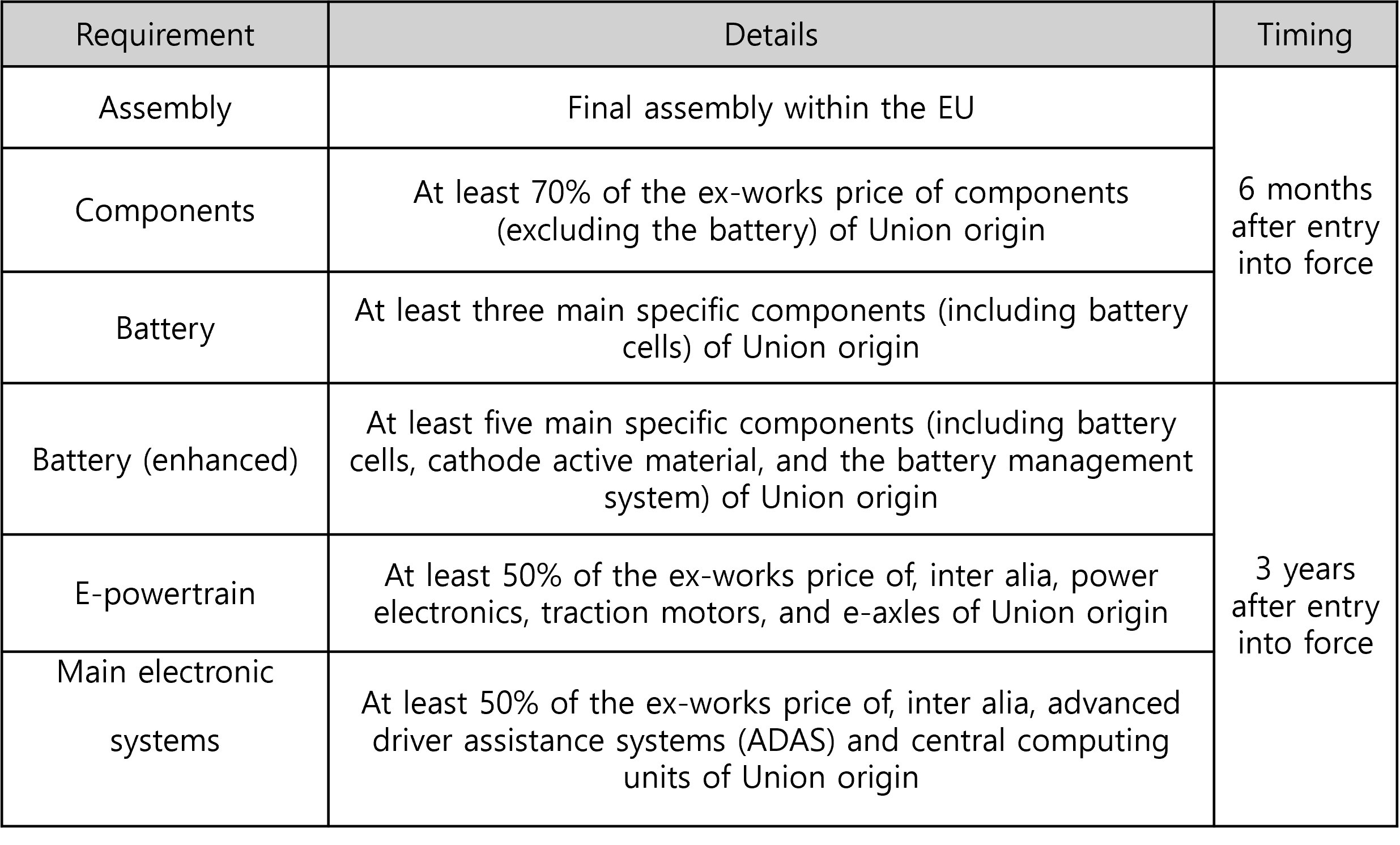
In addition, upon a manufacturer's request, where compliant vehicles assembled in the preceding year account for at least 85% of electric vehicles registered in the Union during the same period, all of the manufacturer's electric vehicles may be deemed compliant for a period of 12 months (Proposal, Annex III). Beginning six months after entry into force, manufacturers must, when issuing the certificate of conformity for a compliant vehicle, provide an accompanying document certifying such compliance (Proposal, Art. 15).
The Proposal also provides for exceptions where the requirements would be difficult to apply. Contracting authorities may decline to apply the requirements where, inter alia, in effect only a single supplier is available, no suitable tenders have been received within the preceding two years, or compliance would entail disproportionate costs; cost differences exceeding 25% may be presumed disproportionate (Proposal, Art. 11(3)). For public support, such circumstances may be presumed where the unavailability of required components or final products is expected to cause delays exceeding seven months, or where the cost of the final product would increase by more than 30% (Proposal, Art. 12(3)).
3. Treatment of Third-Country Companies and Conditions on Foreign Direct Investments
For Korean companies, the key question is whether Korean-made components will be treated as being of Union origin. The Proposal would deem components originating in countries that have concluded a free trade agreement with the EU to be of Union origin (Proposal, Arts. 8 and 9), and Korea, as a party to the Korea–EU FTA, may qualify. However, because the Commission may, after the IAA is adopted, exclude particular countries from this treatment by delegated act, whether Korean-made components will be so treated is likely to depend on the final outcome of the legislative process.
The IAA would also establish new conditions on foreign direct investments (Proposal, Chapter IV). These conditions apply to investments exceeding EUR 100 million in sectors such as batteries, electric vehicles, and related components, where the investor’s home country holds more than 40% of global manufacturing capacity in the relevant sector. Such investments may be approved only if they satisfy at least four of six conditions—including holding no more than 49% of the equity, investing through a joint venture with Union entities, and ensuring that Union workers make up at least 50% of the workforce (the workforce condition being mandatory)—and may not be implemented before approval is granted (Proposal, Arts. 17 and 18). These conditions do not, however, apply to investors and investments covered by commitments under free trade agreements.
4. Outlook and Key Takeaways
Because the IAA remains subject to deliberation by the Council and the European Parliament, the details and timing of the requirements may change in the final legislation. That said, the Proposal already ties public procurement and subsidies to Union assembly and to component and battery sourcing ratios through specific numerical thresholds, and there is discussion that the Union-origin preference may be further strengthened as the legislative process unfolds.
Companies supplying electric vehicles, batteries, or related components to EU would be well advised to review the share of their sales tied to public procurement and subsidies, the status of their assembly and sourcing within the Union, and their origin documentation at each tier of the supply chain. In particular, because the treatment of Korean-made components as being of Union origin will largely determine the IAA’s impact on Korean companies, companies should also closely monitor developments concerning the provisions that define the scope of recognition for components from Korea and other third countries, as well as any delegated act that may supplement them.
[1] The IAA is a legislative proposal currently under deliberation by the Council of the EU and the European Parliament, and its provisions are subject to change.
[2] Refers to the compromise text circulated by the Irish Presidency of the Council in July 2026.
[3] Refers to the draft report presented by the European Parliament's co-rapporteurs in September 2026.
[4] Refers to content originating in the EU (Proposal, Art. 7(1)).
***
LIN LLC has extensive advisory and litigation experience across the mobility sector, ranging from automotive regulatory compliance and administrative proceedings to patent and trade secret disputes. The firm’s Mobility Team brings together attorneys and professionals with deep knowledge of, and hands-on experience in, the automotive and future mobility industries.
For further information on this newsletter, or for any inquiries, please contact the LIN Mobility Team:
Yong-Kap Kim, Attorney at Law (ygkim@law-lin.com, +82 2 3477 8695)
Min-Goo Kang, Attorney at Law (mgkang@law-lin.com, +82 10 3907 9217)
Jeong-Pil Oh, Attorney at Law (jpoh@law-lin.com, +82 2 3477 8695)
Keun-Hyeok Yook, Attorney at Law (keunhyeok.yook@law-lin.com, +82 2 3477 8695)