On October 7, 2026, the Ministry of Finance and Economy (the “MOFE”) published for public comment the Partial Amendment to the Enforcement Decree of the Foreign Exchange Transactions Act (the “Draft Decree”), which expands the scope of virtual asset transfer business to encompass transfers between virtual asset service providers (“VASPs”) and self-hosted wallets, and which sets forth in greater detail, among other things, the registration requirements and procedures and the reporting obligations applicable to virtual asset transfer business.1 If the Draft Decree is finalized as proposed, VASPs that support deposits to and withdrawals from self-hosted wallets may become subject to registration as of December 3, 2026, without the benefit of any transitional relief. In the United States, the Financial Crimes Enforcement Network (“FinCEN”) announced on October 5, 2026, the withdrawal of a proposed rule that would have imposed reporting and other obligations on transactions conducted through financial institutions that involve unhosted wallets. Although the two measures pursue different regulatory objectives, they invite comparison in that they reach opposite conclusions on whether transactions between service providers and self-hosted wallets should be made subject to reporting or notification to the authorities.
In this TLI, we examine those provisions of the Draft Decree that implement the virtual asset transfer business regime, together with the issues that remain open.
1. Scope of Virtual Asset Transfer Business (Article 9-3 of the Draft Decree)
The Foreign Exchange Transactions Act (the “FETA”), as amended by Act No. 21714 (the “Amended Act”), which was promulgated on June 2, 2026, and will take effect on December 3, 2026, defines virtual asset transfer business (“Virtual Asset Transfer Business”) as comprising two categories and delegates the specification of their precise scope to Presidential Decree. The Draft Decree specifies that scope as follows:
In this TLI, we examine those provisions of the Draft Decree that implement the virtual asset transfer business regime, together with the issues that remain open.
1. Scope of Virtual Asset Transfer Business (Article 9-3 of the Draft Decree)
The Foreign Exchange Transactions Act (the “FETA”), as amended by Act No. 21714 (the “Amended Act”), which was promulgated on June 2, 2026, and will take effect on December 3, 2026, defines virtual asset transfer business (“Virtual Asset Transfer Business”) as comprising two categories and delegates the specification of their precise scope to Presidential Decree. The Draft Decree specifies that scope as follows:
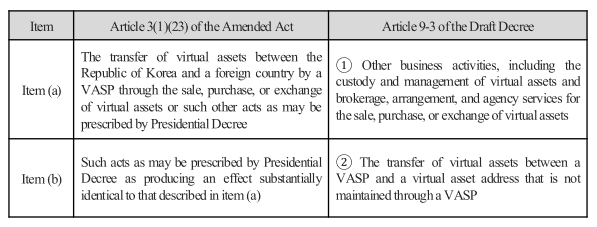
Under paragraph (1), Article 3(1)(23)(a) of the Amended Act applies not only to transfers effected through exchanges but also to those effected through custodians and brokers.
Paragraph (2) implements the delegation under Article 3(1)(23)(b) of the Amended Act. Item (b) provides that Presidential Decree is to prescribe what produces “an effect substantially identical” to the cross-border transfer described in item (a), and the Draft Decree designates transfers between VASPs and self-hosted wallets as falling within that category. In its Regulatory Impact Analysis, the MOFE cited as its rationale that, “given the nature of virtual asset transactions, the concept of a physical border is ambiguous, and virtual assets that flow out to self-hosted wallets are difficult to trace thereafter, thereby producing an effect substantially identical” to that of a cross-border transfer. Paragraph (2) does not condition its application on whether the holder of the self-hosted wallet is a resident under the FETA, nor on the direction of the transfer. Accordingly, on the face of its text, paragraph (2) is construed to cover even a case in which a VASP, at the request of a domestic user, withdraws virtual assets to that user’s own self-hosted wallet. In other words, a VASP that supports deposits to and withdrawals from self-hosted wallets may become subject to registration and notification obligations under the FETA, irrespective of whether any actual cross-border movement is involved.
2. Registration, Notification, and Sanctions
Registration Requirements: The Amended Act requires a VASP seeking to engage in Virtual Asset Transfer Business to register, and sets forth as conditions for registration (i) the filing of a VASP report under the Act on Reporting and Using Specified Financial Transaction Information (the “Specified Financial Information Act”), (ii) a network connection with the Foreign Exchange Information Concentration Agency, and (iii) such facilities and professional personnel as may be prescribed by Presidential Decree (Article 8-2(1) of the FETA). The Draft Decree specifies the last requirement as (a) computer systems capable of smoothly carrying out Virtual Asset Transfer Business and the related post-transaction management, and (b) at least two professional staff members per business office, each of whom has at least two years of experience in foreign exchange business or has completed the requisite training (Article 17-5(2) of the Draft Decree), and does not impose any separate capital requirement.
Notification Obligations: A Virtual Asset Transfer Business operator that performs a virtual asset transfer must notify the details thereof to the Foreign Exchange Information Concentration Agency (i.e., the Bank of Korea) (Article 39(2) of the Draft Decree). The MOFE has stated that it intends to share such data with, and make use of it together with, the National Tax Service, the Korea Customs Service, the Financial Supervisory Service, and the Korea Financial Intelligence Unit. The Draft Decree does not, however, prescribe the details, such as the monetary thresholds for reportable transactions or the items to be notified. Because Article 39(4) of the Enforcement Decree authorizes the Minister of Finance and Economy to establish business processing standards for the Foreign Exchange Information Concentration Agency and to have that agency establish detailed operating standards, such details may well be set forth in those business processing standards or detailed operating standards. Before the effective date, VASPs will need to ascertain the specific notification criteria and establish a notification framework accordingly.
Sanctions: Any person who engages in Virtual Asset Transfer Business without registration, or after obtaining registration by false or other fraudulent means, shall be subject to imprisonment for not more than three years or a criminal fine of not more than KRW 300 million. The same applies to any person who engages in Virtual Asset Transfer Business after filing a false report of business discontinuance, or notwithstanding the revocation of its registration or authorization or an order restricting or suspending its business (Article 27-2(1)(1-2) of the FETA).
Transitional Provisions: Although the Amended Act requires a VASP seeking to engage in Virtual Asset Transfer Business to register in advance (Article 8-2(1)) and penalizes any person who engages in such business without registration, neither the Addenda to the Amended Act nor the Addenda to the Draft Decree provide for any transitional measures with respect to Virtual Asset Transfer Business. Accordingly, it appears that any VASP intending to engage in Virtual Asset Transfer Business on or after December 3, 2026—including any VASP currently conducting such business—must complete registration before commencing such business. However, as there is no provision permitting preparatory acts, such as the filing of a registration application, prior to the effective date, VASPs should monitor guidance from the relevant authorities as to when registration applications may be filed.
3. Matters Not Addressed by the Draft Decree: Payments and Receipts Using Virtual Assets
The Amended Act enumerates “payments and receipts” separately from “transfers of virtual assets” (Articles 21(1) and 25(2) of the FETA), defines Virtual Asset Transfer Business in a subparagraph distinct from that defining foreign exchange business, and provides a separate legal basis for its registration (Articles 3(1)(16) and (23), 8, and 8-2 of the FETA). Nor do the six categories of cross-border payment and settlement business newly established under the Draft Decree (Article 15-2 of the Draft Decree) include payments or receipts using virtual assets. Accordingly, the Virtual Asset Transfer Business regime newly created by the Amended Act and implemented by the Draft Decree imposes registration and notification obligations on transfers of virtual assets, but does not extend to cross-border payments and receipts made using virtual assets. This has implications both for businesses that provide remittance or payment services using virtual assets as an intermediary and for transacting parties that make or accept payment in virtual assets.
First, with respect to businesses, a VASP registered for Virtual Asset Transfer Business is not thereby authorized to provide remittance or payment services, such as using virtual assets as an intermediary to pay out abroad funds received in Korea. Businesses seeking to provide such services must therefore separately assess whether those services constitute foreign exchange business relating to payments and receipts between the Republic of Korea and a foreign country (Article 3(1)(16)(b) of the FETA). In a case in which virtual assets received from an overseas remitter were sold on a domestic exchange and the resulting Korean won proceeds were transferred to a domestic recipient, the court entered a judgment of acquittal on the ground that it had not been proven that the conduct constituted foreign exchange business, because it could not be ascertained whether the relevant virtual assets were tradable on domestic or overseas exchanges, nor the nationality or domestic residency of the sender (Suwon District Court Decision No. 2025No1168, rendered August 26, 2026). The court reasoned that, for a remittance made using virtual assets as an intermediary to constitute foreign exchange business, it must be established that the virtual assets were connected with foreign exchange—for example, that the sender purchased the virtual assets abroad with foreign currency and sent them to the electronic wallet, or that the sending electronic wallet was located abroad. The judgment thus presupposes that a remittance made using virtual assets as an intermediary may constitute foreign exchange business where such a nexus with foreign exchange is established. Once records of cross-border transfers effected through VASPs are notified to the foreign exchange information network following this amendment, such data may well be used in determining whether such a nexus exists.
Second, with respect to transacting parties, a resident who makes or receives a payment other than through a foreign exchange business institution or other similar entity must, as a general rule, report the method of such payment or receipt in advance (Article 16(4) of the FETA). The “means of payment” under Article 3(1)(3)(c) of the FETA, however, presupposes a physical object, such as a voucher or a plastic card, in which monetary value is stored. The Enforcement Decree likewise defines such means of payment as prepaid cards and other similar instruments recognized by the Minister of Finance and Economy (Article 3(2) of the Enforcement Decree), and virtual assets therefore do not qualify as a means of payment.
As a result, it is unclear whether settling a payment obligation by transferring virtual assets constitutes a payment or receipt for purposes of Article 16 of the FETA, yet neither the Amended Act nor the Draft Decree addresses this question. Companies intending to make or accept payment in virtual assets in dealings with overseas counterparties should therefore assess in advance whether the reporting obligation applies.
4. Related Developments Abroad: FinCEN’s Withdrawal of the Proposed Rule
On October 5, 2026, FinCEN, a bureau of the U.S. Department of the Treasury, announced the withdrawal of its proposed rule concerning unhosted wallets, consistent with the Administration’s policy of tailoring the digital asset regulatory framework to its intended purposes. The proposed rule, published on December 23, 2020, had never been finalized. It would have applied to customers’ virtual asset transactions conducted through banks and money
services businesses in which the counterparty uses an unhosted wallet or the like, and would have required (i) reporting to FinCEN of transactions exceeding USD 10,000, (ii) recordkeeping for transactions exceeding USD 3,000, and (iii) in either case, verification of the customer’s identity. The table below compares the obligations that the FinCEN proposed rule would have imposed on such virtual asset transfers with those imposed by the Draft Decree.
Paragraph (2) implements the delegation under Article 3(1)(23)(b) of the Amended Act. Item (b) provides that Presidential Decree is to prescribe what produces “an effect substantially identical” to the cross-border transfer described in item (a), and the Draft Decree designates transfers between VASPs and self-hosted wallets as falling within that category. In its Regulatory Impact Analysis, the MOFE cited as its rationale that, “given the nature of virtual asset transactions, the concept of a physical border is ambiguous, and virtual assets that flow out to self-hosted wallets are difficult to trace thereafter, thereby producing an effect substantially identical” to that of a cross-border transfer. Paragraph (2) does not condition its application on whether the holder of the self-hosted wallet is a resident under the FETA, nor on the direction of the transfer. Accordingly, on the face of its text, paragraph (2) is construed to cover even a case in which a VASP, at the request of a domestic user, withdraws virtual assets to that user’s own self-hosted wallet. In other words, a VASP that supports deposits to and withdrawals from self-hosted wallets may become subject to registration and notification obligations under the FETA, irrespective of whether any actual cross-border movement is involved.
2. Registration, Notification, and Sanctions
Registration Requirements: The Amended Act requires a VASP seeking to engage in Virtual Asset Transfer Business to register, and sets forth as conditions for registration (i) the filing of a VASP report under the Act on Reporting and Using Specified Financial Transaction Information (the “Specified Financial Information Act”), (ii) a network connection with the Foreign Exchange Information Concentration Agency, and (iii) such facilities and professional personnel as may be prescribed by Presidential Decree (Article 8-2(1) of the FETA). The Draft Decree specifies the last requirement as (a) computer systems capable of smoothly carrying out Virtual Asset Transfer Business and the related post-transaction management, and (b) at least two professional staff members per business office, each of whom has at least two years of experience in foreign exchange business or has completed the requisite training (Article 17-5(2) of the Draft Decree), and does not impose any separate capital requirement.
Notification Obligations: A Virtual Asset Transfer Business operator that performs a virtual asset transfer must notify the details thereof to the Foreign Exchange Information Concentration Agency (i.e., the Bank of Korea) (Article 39(2) of the Draft Decree). The MOFE has stated that it intends to share such data with, and make use of it together with, the National Tax Service, the Korea Customs Service, the Financial Supervisory Service, and the Korea Financial Intelligence Unit. The Draft Decree does not, however, prescribe the details, such as the monetary thresholds for reportable transactions or the items to be notified. Because Article 39(4) of the Enforcement Decree authorizes the Minister of Finance and Economy to establish business processing standards for the Foreign Exchange Information Concentration Agency and to have that agency establish detailed operating standards, such details may well be set forth in those business processing standards or detailed operating standards. Before the effective date, VASPs will need to ascertain the specific notification criteria and establish a notification framework accordingly.
Sanctions: Any person who engages in Virtual Asset Transfer Business without registration, or after obtaining registration by false or other fraudulent means, shall be subject to imprisonment for not more than three years or a criminal fine of not more than KRW 300 million. The same applies to any person who engages in Virtual Asset Transfer Business after filing a false report of business discontinuance, or notwithstanding the revocation of its registration or authorization or an order restricting or suspending its business (Article 27-2(1)(1-2) of the FETA).
Transitional Provisions: Although the Amended Act requires a VASP seeking to engage in Virtual Asset Transfer Business to register in advance (Article 8-2(1)) and penalizes any person who engages in such business without registration, neither the Addenda to the Amended Act nor the Addenda to the Draft Decree provide for any transitional measures with respect to Virtual Asset Transfer Business. Accordingly, it appears that any VASP intending to engage in Virtual Asset Transfer Business on or after December 3, 2026—including any VASP currently conducting such business—must complete registration before commencing such business. However, as there is no provision permitting preparatory acts, such as the filing of a registration application, prior to the effective date, VASPs should monitor guidance from the relevant authorities as to when registration applications may be filed.
3. Matters Not Addressed by the Draft Decree: Payments and Receipts Using Virtual Assets
The Amended Act enumerates “payments and receipts” separately from “transfers of virtual assets” (Articles 21(1) and 25(2) of the FETA), defines Virtual Asset Transfer Business in a subparagraph distinct from that defining foreign exchange business, and provides a separate legal basis for its registration (Articles 3(1)(16) and (23), 8, and 8-2 of the FETA). Nor do the six categories of cross-border payment and settlement business newly established under the Draft Decree (Article 15-2 of the Draft Decree) include payments or receipts using virtual assets. Accordingly, the Virtual Asset Transfer Business regime newly created by the Amended Act and implemented by the Draft Decree imposes registration and notification obligations on transfers of virtual assets, but does not extend to cross-border payments and receipts made using virtual assets. This has implications both for businesses that provide remittance or payment services using virtual assets as an intermediary and for transacting parties that make or accept payment in virtual assets.
First, with respect to businesses, a VASP registered for Virtual Asset Transfer Business is not thereby authorized to provide remittance or payment services, such as using virtual assets as an intermediary to pay out abroad funds received in Korea. Businesses seeking to provide such services must therefore separately assess whether those services constitute foreign exchange business relating to payments and receipts between the Republic of Korea and a foreign country (Article 3(1)(16)(b) of the FETA). In a case in which virtual assets received from an overseas remitter were sold on a domestic exchange and the resulting Korean won proceeds were transferred to a domestic recipient, the court entered a judgment of acquittal on the ground that it had not been proven that the conduct constituted foreign exchange business, because it could not be ascertained whether the relevant virtual assets were tradable on domestic or overseas exchanges, nor the nationality or domestic residency of the sender (Suwon District Court Decision No. 2025No1168, rendered August 26, 2026). The court reasoned that, for a remittance made using virtual assets as an intermediary to constitute foreign exchange business, it must be established that the virtual assets were connected with foreign exchange—for example, that the sender purchased the virtual assets abroad with foreign currency and sent them to the electronic wallet, or that the sending electronic wallet was located abroad. The judgment thus presupposes that a remittance made using virtual assets as an intermediary may constitute foreign exchange business where such a nexus with foreign exchange is established. Once records of cross-border transfers effected through VASPs are notified to the foreign exchange information network following this amendment, such data may well be used in determining whether such a nexus exists.
Second, with respect to transacting parties, a resident who makes or receives a payment other than through a foreign exchange business institution or other similar entity must, as a general rule, report the method of such payment or receipt in advance (Article 16(4) of the FETA). The “means of payment” under Article 3(1)(3)(c) of the FETA, however, presupposes a physical object, such as a voucher or a plastic card, in which monetary value is stored. The Enforcement Decree likewise defines such means of payment as prepaid cards and other similar instruments recognized by the Minister of Finance and Economy (Article 3(2) of the Enforcement Decree), and virtual assets therefore do not qualify as a means of payment.
As a result, it is unclear whether settling a payment obligation by transferring virtual assets constitutes a payment or receipt for purposes of Article 16 of the FETA, yet neither the Amended Act nor the Draft Decree addresses this question. Companies intending to make or accept payment in virtual assets in dealings with overseas counterparties should therefore assess in advance whether the reporting obligation applies.
4. Related Developments Abroad: FinCEN’s Withdrawal of the Proposed Rule
On October 5, 2026, FinCEN, a bureau of the U.S. Department of the Treasury, announced the withdrawal of its proposed rule concerning unhosted wallets, consistent with the Administration’s policy of tailoring the digital asset regulatory framework to its intended purposes. The proposed rule, published on December 23, 2020, had never been finalized. It would have applied to customers’ virtual asset transactions conducted through banks and money
services businesses in which the counterparty uses an unhosted wallet or the like, and would have required (i) reporting to FinCEN of transactions exceeding USD 10,000, (ii) recordkeeping for transactions exceeding USD 3,000, and (iii) in either case, verification of the customer’s identity. The table below compares the obligations that the FinCEN proposed rule would have imposed on such virtual asset transfers with those imposed by the Draft Decree.
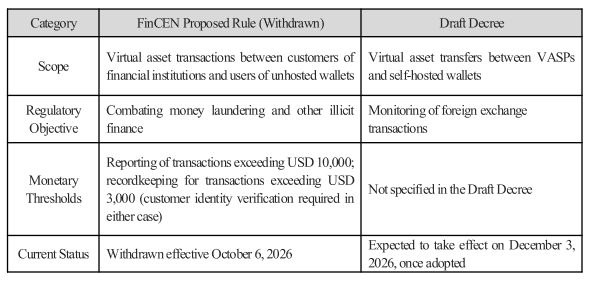
Although the two regimes serve different regulatory objectives, the United States has elected not to adopt reporting obligations specifically tailored to transfers between service providers and self-hosted wallets, whereas in Korea, registration and notification obligations are scheduled to apply from December 3, 2026. Accordingly, businesses operating both in Korea and abroad may need to adopt jurisdiction-specific internal control standards for self-hosted wallet transactions, and will need to establish a separate registration and notification framework for deposits to and withdrawals from self-hosted wallets by domestic users.
5. Implications
To date, the FETA has delineated its regulatory perimeter principally by reference to the cross-border nature of a transaction. The Draft Decree, by contrast, adopts a new criterion for virtual assets: whether the assets leave the control of a VASP. Given that major exchanges currently support deposits to and withdrawals from self-hosted wallets, registration for Virtual Asset Transfer Business will, in addition to the report required under the Specified Financial Information Act, effectively function as yet another license required to conduct business. Compliance with obligations under the FETA should accordingly be managed with a view to maintaining that license.
In addition, the Regulatory Impact Analysis cites, as the impetus for the amendment, the growing potential for virtual assets (including stablecoins) to be used as a means of cross-border payment, coupled with the absence of a regulatory framework under the FETA. The amendment, however, focuses on establishing a framework for identifying cross-border transfers of virtual assets and does not include provisions governing transactions in which virtual assets are used as a means of payment. In light of the concerns articulated by the government, further discussion of this issue is likely to follow, and the virtual asset transfer data accumulated as the new regime is implemented may serve as the foundation for that discussion. Service providers and other companies involved in remittances or payments using virtual assets should therefore review and document their business models, transaction structures, and risk management measures in advance so that they are well positioned to respond to future regulatory developments.
5. Implications
To date, the FETA has delineated its regulatory perimeter principally by reference to the cross-border nature of a transaction. The Draft Decree, by contrast, adopts a new criterion for virtual assets: whether the assets leave the control of a VASP. Given that major exchanges currently support deposits to and withdrawals from self-hosted wallets, registration for Virtual Asset Transfer Business will, in addition to the report required under the Specified Financial Information Act, effectively function as yet another license required to conduct business. Compliance with obligations under the FETA should accordingly be managed with a view to maintaining that license.
In addition, the Regulatory Impact Analysis cites, as the impetus for the amendment, the growing potential for virtual assets (including stablecoins) to be used as a means of cross-border payment, coupled with the absence of a regulatory framework under the FETA. The amendment, however, focuses on establishing a framework for identifying cross-border transfers of virtual assets and does not include provisions governing transactions in which virtual assets are used as a means of payment. In light of the concerns articulated by the government, further discussion of this issue is likely to follow, and the virtual asset transfer data accumulated as the new regime is implemented may serve as the foundation for that discussion. Service providers and other companies involved in remittances or payments using virtual assets should therefore review and document their business models, transaction structures, and risk management measures in advance so that they are well positioned to respond to future regulatory developments.
* * *
LIN’s Digital Asset Team under the APT (AI, Platform, Technology) Group provides
companies with strategic, one-stop total legal solutions for regulatory issues.
If you have any questions regarding the above, please feel free to contact LIN’s Digital Asset Team (Tel. +82 - 2-3477-8695), Team Leader Taeeon Koo (tekoo@law-lin.com), Attorney Hyunsu Do (hsdo@law-lin.com), or Attorney Seoyeon Ahn (syahn@law-lin.com).
LIN’s Digital Asset Team under the APT (AI, Platform, Technology) Group provides
companies with strategic, one-stop total legal solutions for regulatory issues.
If you have any questions regarding the above, please feel free to contact LIN’s Digital Asset Team (Tel. +82 - 2-3477-8695), Team Leader Taeeon Koo (tekoo@law-lin.com), Attorney Hyunsu Do (hsdo@law-lin.com), or Attorney Seoyeon Ahn (syahn@law-lin.com).
1.The public comment period closed on October 26, 2026. Once adopted, the amendment is expected to take effect on December 3, 2026, the date on which the recent amendments to the Foreign Exchange Transactions Act take effect. Because the Draft Decree has not yet been reviewed by the Ministry of Government Legislation, it remains subject to revision as the rulemaking process proceeds.
2.https://www.federalregister.gov/documents/2026/10/06/2026-20430/requirements-for-certain-transactions-involving-convertible-virtual-currency-or-digital-assets