In our previous TLI, we examined the provisions governing the Virtual Asset Transfer Business under the Partial Amendment to the Enforcement Decree of the Foreign Exchange Transactions Act published for public comment on October 7, 2026 (the “Draft Decree”). As we noted there, the Draft Decree subjects transfers of virtual assets to registration and notification requirements, yet leaves cross-border payments and receipts made by means of virtual assets unaddressed. In this TLI, we turn to the provisions of the same Draft Decree governing the cross-border payment and settlement business—the business line through which cross-border payments and settlements are conducted.
The Foreign Exchange Transactions Act (the “FETA”), as amended, consolidates the small-amount overseas remittance business and the other specialized foreign exchange businesses (i.e., electronic payment gateway (“PG”) business, electronic currency business, and electronic prepayment business) into a single category: the cross-border payment and settlement business. The Draft Decree adds cross-border escrow services and cross-border electronic bill presentment and payment services to this category, establishing six distinct types of cross-border payment and settlement business, each of which requires registration (Articles 15-2 and 15-6 of the Draft Decree). The Draft Decree also requires all cross-border payment and settlement service providers (the “CBPS Providers”)—not merely small-amount overseas remittance providers, as was previously the case—to register, among other things, their business methods, the accounts they use, and their foreign partners, to report any subsequent changes to such information, and to post a performance guarantee deposit. In addition, a single instance of conducting foreign exchange business beyond the scope of registration now constitutes grounds for revocation of the registration or authorization.
In this TLI, we consider what these provisions mean for market participants, and we revisit the question left open in our previous TLI—cross-border payments and settlements by means of virtual assets—in light of the cross-border payment and settlement framework and the legislative plans recently announced by the Bank of Korea.
1. Six Types of Cross-Border Payment and Settlement Business (Article 15-2 of the Draft Decree)
The Draft Decree defines the foreign exchange business falling under Article 8(3)(2) of the FETA as “Cross-Border Payment and Settlement Business” and divides it into the following six types according to the manner in which the business is conducted and the scope of transactions handled.
The Foreign Exchange Transactions Act (the “FETA”), as amended, consolidates the small-amount overseas remittance business and the other specialized foreign exchange businesses (i.e., electronic payment gateway (“PG”) business, electronic currency business, and electronic prepayment business) into a single category: the cross-border payment and settlement business. The Draft Decree adds cross-border escrow services and cross-border electronic bill presentment and payment services to this category, establishing six distinct types of cross-border payment and settlement business, each of which requires registration (Articles 15-2 and 15-6 of the Draft Decree). The Draft Decree also requires all cross-border payment and settlement service providers (the “CBPS Providers”)—not merely small-amount overseas remittance providers, as was previously the case—to register, among other things, their business methods, the accounts they use, and their foreign partners, to report any subsequent changes to such information, and to post a performance guarantee deposit. In addition, a single instance of conducting foreign exchange business beyond the scope of registration now constitutes grounds for revocation of the registration or authorization.
In this TLI, we consider what these provisions mean for market participants, and we revisit the question left open in our previous TLI—cross-border payments and settlements by means of virtual assets—in light of the cross-border payment and settlement framework and the legislative plans recently announced by the Bank of Korea.
1. Six Types of Cross-Border Payment and Settlement Business (Article 15-2 of the Draft Decree)
The Draft Decree defines the foreign exchange business falling under Article 8(3)(2) of the FETA as “Cross-Border Payment and Settlement Business” and divides it into the following six types according to the manner in which the business is conducted and the scope of transactions handled.
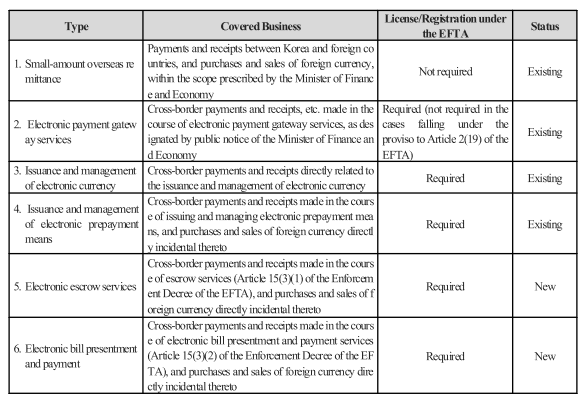
Types 2 through 6 are each defined as cross-border payments and receipts tied to a business regulated under the Electronic Financial Transactions Act (the “EFTA”). Accordingly, registration for any of these types in principle requires that the applicant already hold a license or registration under the EFTA for the relevant business, and that it maintain equity capital at or above the minimum capital prescribed under the same Act (Article 15-3(2)(1)(b) and (7) of the Draft Decree). The small-amount overseas remittance business is the only type that does not presuppose an EFTA-regulated business, and its equity capital requirement remains unchanged at KRW 1 billion.
Notably, however, Type 2 (electronic payment gateway services) also extends to businesses that are not subject to registration under the EFTA. The amended EFTA (Act No. 21205, promulgated December 16, 2025, and effective December 17, 2026) carves out from the definition of electronic payment gateway services cases in which a business, in the course of conducting another line of business such as online marketplace intermediation, provides settlement services for consideration on an ancillary basis (proviso to Article 2(19)). The Draft Decree nonetheless brings such cases within Type 2, while disapplying the registration requirements under the EFTA and leaving the equity capital requirement to be prescribed by public notice of the Minister of Finance and Economy (Article 15-2(2) and the provisos to Article 15-3(2)(1)(b) and (7) of the Draft Decree). In other words, although an online marketplace platform is not required to register as an electronic payment gateway service provider under the EFTA, it may well be required to register for Type 2 Cross-Border Payment and Settlement Business under the FETA if it directly receives and settles funds between overseas sellers and domestic buyers, or between domestic sellers and overseas buyers. Such platforms should therefore separately assess whether registration under the FETA is required and monitor the equity capital requirement to be set by public notice.
In addition, any person intending to engage in two or more types of business must register separately for each type (Article 15-6 of the Draft Decree). Registration for Cross-Border Payment and Settlement Business is thus not obtained on a comprehensive, one-time basis but type by type, so that the scope of a provider’s registration is determined by the type into which each of its services falls. As discussed below, this point is critical, because conducting business beyond the scope of registration constitutes grounds for revocation of the registration.
2. Key Changes to the Obligations of CBPS Providers
Businesses that, as of the effective date of the Draft Decree (December 3, 2026), are registered for the small-amount overseas remittance business or other specialized foreign exchange business under the pre-amendment regime will be deemed registered for the type of Cross-Border Payment and Settlement Business corresponding to their existing business, but must come into compliance with the amended registration requirements by June 30, 2027 (Article 2 of the Addenda to the Draft Decree). By contrast, businesses that have not obtained such registration under the pre-amendment regime do not benefit from the transitional provisions and must newly register; this includes businesses seeking to engage in cross-border escrow or cross-border electronic bill presentment and payment—business types newly introduced by the Draft Decree. The treatment of the online marketplace platforms discussed above appears likely to turn on whether they were previously registered. A platform registered as an electronic payment gateway service provider under the EFTA and also registered for other specialized foreign exchange business under the FETA would be deemed registered for Cross-Border Payment and Settlement Business, but must satisfy the amended requirements—including the equity capital requirement to be set by public notice—by June 30, 2027. A platform lacking such prior registrations, by contrast, would on our reading be required to register anew.
Under the Draft Decree, the obligations to register specified business information, to report subsequent changes to that information, and to post a performance guarantee deposit—each of which previously applied only to small-amount overseas remittance providers—now extend to all CBPS Providers, including PG business operators and electronic prepayment business operators. The Draft Decree also introduces new qualified personnel standards for providers engaged in multiple types of business, together with new business conduct standards. The specific changes and their practical implications are as follows.
- Registration and reporting of changes: A CBPS Provider must register the type of business; the scope of transactions handled, including the countries covered and the currencies handled; the method of conducting business; the accounts held in its own name to be used for the business; and matters concerning its foreign partners (Article 15-3(1) of the Draft Decree). It must also report to the authorities before making any change to such information (Article 16(1)(3) of the Draft Decree). According to the Regulatory Impact Analysis, these amendments are designed to hold the cross-border payment and settlement business as a whole to the standard of registered-information management that has applied to the small-amount overseas remittance business, thereby closing gaps in the oversight of cross-border payments and settlements conducted in comparable sectors. Consequently, changes to business methods, the accounts used for the business, and matters concerning foreign partners, which under the pre-amendment regime were reportable only by small-amount overseas remittance providers, must now also be reported by CBPS Providers of the other five types. For instance, a CBPS Provider that engages a new foreign partner or replaces an existing one must report the change, and failure to do so may result in a two-month business suspension under the applicable sanction standards (Annex 2, Item 2(e) of the Enforcement Decree of the FETA).
- Qualified personnel: A CBPS Provider must retain at least two individuals who have either been engaged in foreign exchange business for two years or more or completed training prescribed by the Minister of Finance and Economy; a provider engaged in three or more types of Cross-Border Payment and Settlement Business must retain at least five such individuals (Article 15-3(2)(5) of the Draft Decree).
- Performance guarantee deposit: Whereas the obligation to deposit a performance guarantee previously applied only to small-amount overseas remittance providers, the Draft Decree shifts that obligation to CBPS Providers generally. The deposit must be at least KRW 300 million, with the specific amount and related matters to be prescribed by the Minister of Finance and Economy in light of transaction volume. That said, a business designated by public notice of the Minister of Finance and Economy as already implementing measures to protect user funds under other laws may be exempted from the deposit obligation (Article 17-2(1) of the Draft Decree). One example of such a measure is the obligation imposed on PG business operators under the amended EFTA (effective December 17, 2026) to have their settlement funds managed by an outside institution (Article 25-4(1)). Whether businesses that comply with this obligation will be exempt from the performance guarantee deposit obligation appears to be a matter to be determined by public notice.
- Business conduct standards: The provision governing security standards, the designation of a chief information security officer, the reporting of terms and conditions, and related matters, which previously applied only to small-amount overseas remittance providers (Article 15-4 of the current Enforcement Decree of the FETA), has been deleted. In its place, both money exchange businesses and CBPS Providers—that is, all specialized foreign exchange business operators registered under Article 8(3) of the FETA—must comply with standards prescribed by the Minister of Finance and Economy with respect to information technology, and the management and protection of user funds (Article 17(1)(4) of the Draft Decree).
3. Revocation of Registration for Business Conducted Beyond the Scope of Registration
Where a specialized foreign exchange business operator conducts foreign exchange business beyond the scope of its registration (in violation of Article 8(3) of the FETA), the Draft Decree sets the applicable sanction standard at revocation of the registration or authorization (Annex 2, Item 2(d) of the Draft Decree). The Regulatory Impact Analysis explains that, under the pre-amendment regime, even where unregistered business such as illegal remittance was detected, registration could be revoked only if, following a three-month business suspension, a further violation was detected three months later. Following the amendment, a single violation will suffice for revocation. The cap on the penalty surcharge imposed in lieu of a business suspension will also be raised from 20–70% to 40–100% of the profits derived from the violation (Annex 3 of the Draft Decree).
The significance of this standard for CBPS Providers must be understood in conjunction with the type-by-type registration structure. For example, if a provider registered only for foreign exchange business relating to the issuance and management of electronic prepayment means (Article 15-2(4) of the Draft Decree) adds payment gateway or escrow functions for overseas merchants, those functions may constitute foreign exchange business under Item 2 or Item 5 of the same Article, for which the provider is not registered. Because registration for Cross-Border Payment and Settlement Business is required on a type-by-type basis (Article 15-6 of the Draft Decree), conducting a type of business for which the provider is not registered amounts to conducting foreign exchange business without registration under Article 8(3) of the FETA with respect to that business, and may be subject to criminal penalties (Article 27-2(1)(1) of the FETA). The Regulatory Impact Analysis likewise characterizes such conduct beyond the scope of registration as “unregistered foreign exchange business.” CBPS Providers should therefore check that all cross-border services they currently offer fall within the types of business for which they are deemed registered under the transitional provisions, and, when launching new services or restructuring existing ones, make sure that the services remain within the scope of the types for which they are registered.
4. The Regulatory Gap for Cross-Border Payments and Settlements Using Virtual Assets
As explained in our previous TLI, registration for the Virtual Asset Transfer Business concerns the transfer of virtual assets and does not extend to permitting cross-border payments and settlements by means of virtual assets. The Draft Decree’s provisions on the cross-border payment and settlement business do not fill this gap either. With the exception of the small-amount overseas remittance business, all six types presuppose a business regulated under the EFTA, and none of them covers cross-border payments and settlements using virtual assets (including stablecoins). In short, it appears that neither pillar of the Draft Decree provides a type of registration under which a business may engage in cross-border payments and settlements using virtual assets. Yet a remittance effected through virtual assets may, where a sufficient nexus to foreign exchange is established, constitute foreign exchange business relating to payments and receipts between Korea and foreign countries (Article 3(1)(16)(b) of the FETA).1 Offering such services as a business in the absence of any available registration type therefore carries the risk of constituting unregistered foreign exchange business.
Caution is also warranted where an already-registered CBPS Provider seeks to use stablecoins or other virtual assets for overseas settlement. Because business methods and foreign partners are among the matters a CBPS Provider must register, the provider should, at a minimum, check whether the change must be reported; and if the new method is found to fall outside the scope of the type for which it is registered, the provider’s registration may be revoked. Furthermore, if such a settlement arrangement involves holding or transferring virtual assets on behalf of customers, the provider should also consider whether it must file a report as a virtual asset service provider under the Act on Reporting and Using Specified Financial Transaction Information and register for the Virtual Asset Transfer Business.
Legislation addressing this area is, however, in preparation. In its report on its operations submitted for the National Assembly’s annual audit on October 22, 2026, the Bank of Korea stated that it plans to prepare, together with the government and within this year, an amendment to the FETA to regulate stablecoins as a means of payment, among other things.2 A lawmaker-sponsored bill adding stablecoins to the means of payment under the FETA has also been introduced in the National Assembly.3 As for the proposed Digital Asset Basic Act, which would govern the digital asset market as a whole, the Chairman of the Financial Services Commission stated during the National Assembly audit that intra-governmental consultations had reached their final stage;4 the government bill, however, has yet to be submitted to the National Assembly.
Businesses should bear two points in mind. First, because the planned amendment to the FETA targets stablecoins, cross-border payments and settlements using other virtual assets may continue to face the same issue even after the amendment. Second, because the question of who may provide such services, and subject to what registration, is likely to be determined jointly by the planned amendment to the FETA and the proposed Digital Asset Basic Act, businesses should, in the meantime, design their business structures within the scope of their existing registrations.
5. Implications
The Draft Decree’s provisions on both the Virtual Asset Transfer Business and the Cross-Border Payment and Settlement Business share a common focus: enabling the foreign exchange authorities to track cross-border flows of funds and virtual assets that pass through non-bank businesses. This is illustrated by the requirement that transfers of virtual assets be notified to the Foreign Exchange Information Concentration Agency, and by the designation of CBPS Providers’ accounts, foreign partners, and business methods as matters subject to registration. The Regulatory Impact Analysis likewise explains that, if such information is omitted or not updated following a change, it becomes “difficult during examinations and supervision to assess actual fund flows and compliance with the registered scope of business.” Accordingly, registration is not a one-time exercise: businesses must ensure, on an ongoing basis, that their registered information continues to reflect their actual transaction structures. Because business decisions such as entering into arrangements with foreign partners, changing settlement structures, or launching new services may in themselves trigger an obligation to report changes or call into question whether the business remains within the scope of its registration, businesses should assess, before implementing any such decision, whether a report or additional registration is required under the FETA.
This regulatory approach also offers a useful indication of how a framework for cross-border payments and settlements using virtual assets may ultimately take shape. The Bank of Korea’s announcement that it will pursue a FETA amendment to “regulate stablecoins as a means of payment” may be read as signaling an intent to address stablecoins within the existing foreign exchange management framework rather than as a separate domain. Viewed in this light, whatever form of registration is ultimately adopted, the underlying principle that the authorities must be able to trace the routes of fund flows and identify counterparties is likely to be maintained. Businesses contemplating cross-border payment and settlement services using virtual assets would therefore be well advised to put in place, even before the framework is finalized, structures that allow them to manage transaction routes, counterparties, and transfer records transparently. Doing so is not only required under the current regime, but will also reduce the burden of adapting to whatever framework is ultimately introduced.
* * *
LIN’s Digital Asset Team under the APT (AI, Platform, Technology) Group provides
companies with strategic, one-stop total legal solutions for regulatory issues.
If you have any questions regarding the above, please feel free to contact LIN’s Digital Asset Team (Tel. +82 - 2-3477-8695),
Team Leader Taeeon Koo (tekoo@law-lin.com), Attorney Hyunsu Do (hsdo@law-lin.com), or Attorney Seoyeon Ahn (syahn@law-lin.com).
LIN’s Digital Asset Team under the APT (AI, Platform, Technology) Group provides
companies with strategic, one-stop total legal solutions for regulatory issues.
If you have any questions regarding the above, please feel free to contact LIN’s Digital Asset Team (Tel. +82 - 2-3477-8695),
Team Leader Taeeon Koo (tekoo@law-lin.com), Attorney Hyunsu Do (hsdo@law-lin.com), or Attorney Seoyeon Ahn (syahn@law-lin.com).
1 Suwon District Court Decision No. 2025No1168, rendered August 26, 2026
2 Digital Asset, “Government and BOK to Pursue FETA Amendment to ‘Regulate Stablecoins as a Means of Payment’” (October 23, 2026) (in Korean), https://www.digitalasset.works/news/articleView.html?idxno=43792
3 Partial Amendment to the Foreign Exchange Transactions Act, Bill No. 2213738, introduced by Rep. Park Sung-hoon on [October 28, 2025] (in Korean), https://likms.assembly.go.kr/bill/bi/billDetailPage.do?billId=PRC_N2O5M1N0L2M2K1K0T0R3R3Q1Q9O7P6
4 Newspim, “[2026 National Assembly Audit] Lee Eog-weon: ‘Government Bill for Digital Asset Basic Act in Final Stage of Consultations’” (October 22, 2026) (in Korean), https://www.newspim.com/news/view/20261022000665
2 Digital Asset, “Government and BOK to Pursue FETA Amendment to ‘Regulate Stablecoins as a Means of Payment’” (October 23, 2026) (in Korean), https://www.digitalasset.works/news/articleView.html?idxno=43792
3 Partial Amendment to the Foreign Exchange Transactions Act, Bill No. 2213738, introduced by Rep. Park Sung-hoon on [October 28, 2025] (in Korean), https://likms.assembly.go.kr/bill/bi/billDetailPage.do?billId=PRC_N2O5M1N0L2M2K1K0T0R3R3Q1Q9O7P6
4 Newspim, “[2026 National Assembly Audit] Lee Eog-weon: ‘Government Bill for Digital Asset Basic Act in Final Stage of Consultations’” (October 22, 2026) (in Korean), https://www.newspim.com/news/view/20261022000665